AI Calling Inside the CRM: How Voice Agents Are Changing Salesforce Communication
As pioneers in the CRM space, Salesforce could still be accredited for handling client relationships, sales activities, lead opportunities, service cases, and client data. Yet, one essential aspect of client communication that has remained beyond the CRM is phone call. Since, different teams continue to use separate phones (dialers and mobiles), call-center platforms, etc. to interact with customers, a gap is created between the interaction, as well as client record. For instance, manual entry of call details, missed follow-ups, and customer context might remain inconsistent.
This is where AI voice agents are changing the game. With AI calling directly paired with CRM workflows, businesses are easily moving from simple call recordings to smart voice agents that participate in client conversations. With this new approach of AI calling Salesforce, AI besides making and receiving calls can understand spoken language, qualify prospects, answer routine queries, schedule appointments, gather information, and trigger CRM actions depending on interactions.
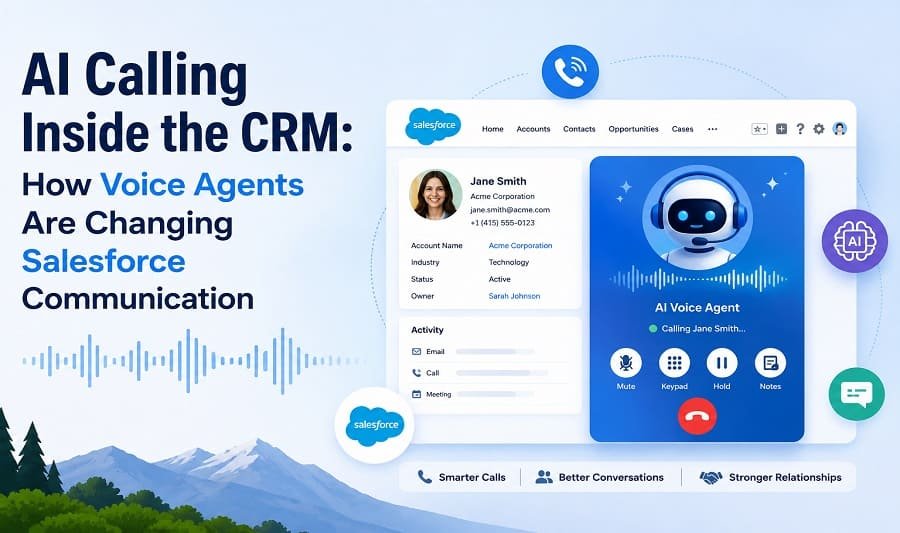
What Is AI Calling in Salesforce?
It refers to the use of AI-powered voice agents to automate phone interactions while working with customers and business data within Salesforce. Contrary to a traditional set-up where a sales or a service rep is required to initiate a conversation, which is later followed by recording the outcome. This is where an AI voice agent offloads the burden from a human agent.
Say when a new lead gets inside Salesforce, an AI agent could call the prospect by default, brief about the company, ask eligibility questions, identify the requirement of a prospect, and update the relevant CRM fields. If the lead showcases buying intent, the system could route the prospect to a salesperson.
The objective is beyond automated dialing. It is smart communication paired with CRM data and workflows.
Why Businesses Are Turning to AI Calling for Salesforce?
Phone conversations continue to play a significant role across various business functions and industries. However, it’s practically not possible for human teams to answer every call, reply to every query, or outreach leads at the right time.
This creates multiple operational challenges:
- Leads might wait long hours for a callback.
- Sales teams spend significant time tackling redundant interactions.
- Client data may be scattered across various systems.
- Call notes can be inadequate, inconsistent, or input after a delay.
- Crucial follow-ups can easily be missed.
- Managers may have restricted visibility into client interactions.
- High call volumes can grow pressure on sales and support teams.
AI calling for Salesforce helps manage these challenges by taking voice automation directly within CRM-driven workflows.
Rather than considering every phone call as a separate interaction, businesses can connect voice interactions with customer data, sales processes, follow-ups, and CRM actions.
Lead → AI Call → Qualification → Salesforce Update → Follow-Up → Sales Opportunity
This creates a more connected workflow in which customer conversations can directly support business processes, optimize response times, and decrease the manual effort included in managing calls.
How AI Voice Agents Function Inside Salesforce?
An AI voice agent brings together multiple technologies such as speech recognition, natural-language, conversational AI, telephony set-up, workflow automation and more.
A typical interaction can work as follows:
1. Salesforce provides customer context
The AI agent can get access to relevant data available via the CRM integration, such as lead details, client data, prior interactions, case data and more subject to permissions and data-access policies.
2. The AI Agent Initiates or Handles the Call
Based on business requirements, the AI agent can respond to incoming calls or place outbound calls. It can state its identity, identify the call’s purpose, and start the discussion naturally. For example:
“Hello, I’m calling regarding your recent inquiry from xyz services. I’d like to understand more about what you’re seeking and see how we can help.”
3. The Agent comprehends the Conversation
Unlike traditional IVR systems that mandate callers to understand caller intent rather than follow rigid menus, conversational voice AI can process what callers say and reply accordingly.
For instance, a prospect might be interested but says:
It would be good if someone connects with me by next Monday.”
The AI agent can comprehend the customer’s intent, note the preferred follow-up date, and trigger a Salesforce task or workflow for the sales team.
4. The CRM record is updated
After or during the interaction, important details can be passed back into Salesforce.
This could include:
- Call consequence
- Lead qualification
- Client intent
- Appointment details
- Outreach date
- Conversation summary
- Client preferences
- Escalation requirements
5. Human employees take over when required
AI need not manage every interaction autonomously. Complex, or high-value interactions can be escalated to human representatives.
This creates a hybrid model where AI manages mundane interactions while employees focus on interactions needing reasoning, understanding, discussion, or specialized expertise.
AI Calling from Any CRM: Beyond Salesforce
While Salesforce has become a preferred CRM platform, several businesses rely on a diverse mix of systems to manage clients, as well as operational data.
Organizations may use CRM platforms like Microsoft Dynamics, HubSpot, Zoho, industry-specific platforms, and more. With this, AI calling from any CRM becomes an important competence.
Rather than compelling businesses to switch to a new CRM from their existing CRM infrastructure, an AI voice platform can easily integrate with already existing systems. This enables businesses to bring voice automation into their existent processes while keeping client data and workflows connected.
AI Calling Agent Integration with Any CRM
AI calling agent integration with any CRM allows businesses to implement voice AI without establishing an independent customer-data environment. Through APIs, contact synchronization, webhooks, call logging, custom fields, and more, voice agents can tie up with existing systems. This enables businesses to automate calling while ensuring consistent client data and processes across multiple CRMs.
Final Words:
AI voice agents have taken CRM communication to the next level by connecting voice discourses directly with client records, sales and service workflows. From lead qualifications and follow-ups to appointment support and scheduling, the best AI voice agent can automate high-volume interactions while enabling employees to shift their focus on complex tasks. As businesses adopt interactive experiences, AI calling for Salesforce and AI calling agent integration with any CRM can make voice a smart, connected part of the CRM ecosystem.
Author Profile

- I am the owner of the blog readree.com. My love for technology began at a young age, and I have been exploring every nook and cranny of it for the past eight years. In that time, I have learned an immense amount about the internet world, technology, Smartphones, Computers, Funny Tricks, and how to use the internet to solve common problems faced by people in their day-to-day lives. Through this blog, I aim to share all that I have learned with my readers so that they can benefit from it too. Connect with me : Sabinbaniya2002@gmail.com
Latest entries
 BlogSeptember 17, 2026Keeping Your Plane Safe for Flight
 Artificial IntelligenceAugust 31, 2026AI Calling Inside the CRM: How Voice Agents Are Changing Salesforce Communication
 BlogAugust 13, 2026Need The Current Z library Official Domain? Here Is What To Know
 How ToAugust 1, 2026How Modern Enterprises Are Replacing Legacy Workflows