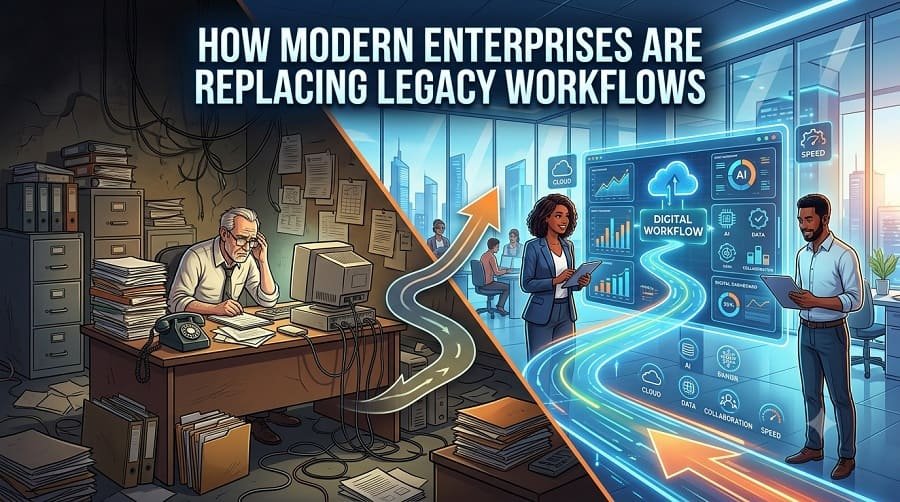
How Modern Enterprises Are Replacing Legacy Workflows
Legacy workflows are steadily increasing enterprise operating costs. Manual approvals, disconnected spreadsheets, and legacy systems are still at the core of many big organizations, yet these companies expect customers to keep pace, moving faster than ever. The end result is a steadily growing gap between what the business needs and what its in-house processes actually manage to deliver.
The gap itself comes at a cost. Research from McKinsey and BCG has consistently found that the vast majority of large-scale change initiatives fall short of their goals. It’s largely because organizations underestimate the complexity of restructuring ingrained processes rather than just upgrading the technology itself. In short, enterprise leaders need to take note. Replacing legacy workflows is no simple IT upgrade. However, it’s a matter of business survival.
This is exactly why digital transformation service providers have become more than just nice-to-have consultants, as they are now vital growth partners. They bring the know-how, technical expertise, and change management discipline that internal teams often find themselves too busy to develop on their own. In this article, we are going to explain why legacy workflows are becoming a problem, what modern enterprises are replacing them with, and how the right partner for change can convert modernization initiatives into a tangible return on investment.
Why Legacy Workflows Are Proving To Be A Problem For Enterprises
Most legacy workflows were never designed with today’s demands in mind. They were built to solve the problems of yesterday and have simply kept going because no one has ever stopped to work out how much they are really costing.
Take an example of a mid-sized logistics firm that still handles shipment exceptions through email chains and manual spreadsheets. Each exception might tie up a coordinator for 20 to 30 minutes to sort out. When you multiply that across thousands of monthly exceptions, the business is essentially paying the equivalent of a full-time salary just to transfer information back and forth between systems that really should already be talking to one another.
Compounding Risks Across The Business
Legacy workflows not only slow teams down but also introduce risk that just keeps growing:
- Compliance problems caused by manual data entry and inadequate audit records.
- Talent burnout as skilled staff leave because they don’t want to keep working on outdated software.
- Decision-making paralysis because leaders just don’t have the real-time view of operations they need.
- Integration debt, which makes every new system harder to link up than the last.
Each of these problems on its own is something that could be handled. Taken together, though, they turn an organization into a business that reacts to change rather than one that leads it.
What Modern Enterprises Are Moving Towards?
These are the following things that enterprises are nowadays moving towards in 2026.
#1. From Manual Tasks To Intelligent Automation
Forward-thinking businesses are replacing slow, rules-based tasks with advanced automation that can handle exceptions, not just repetitive steps. This shift sees teams move from processing transactions to having real control over how things turn out.
A global retail brand, for example, replaced its manual invoice reconciliation process with an automated workflow that can read, validate, and send invoices on to the next stages without human intervention in standard cases. Finance teams can spend their time on high-level vendor negotiations rather than data entry. In addition, reconciliation time has decreased from days to hours.
#2. From Siloed Systems To Connected Platforms
Legacy systems all too often trap valuable information inside individual departments. Modern businesses are pulling these silos together into connected platforms where sales, operations, and finance work together. Customer service can also draw on the same information in real time.
It’s connectivity that lets a marketplace operator get a handle on inventory, fulfillment, and customer sentiment all in one place, rather than having to wrestle with three separate reports each week.
#3. From Static Reporting to Making Better Decisions
The way things used to be, reports were generated after the fact. Now, with modern architectures, we can get insight into what’s going on as it happens. Plus, it lets leadership spot a potential problem before it’s even had a chance to impact customers. This change turns data from a bunch of old news into a forward-looking tool to help make informed decisions. And that is a real game-changer in fast-moving markets.
The Role of Digital Transformation Service Providers
Replacing old workflows requires eliminating manual tasks, processes, and tech at the same time. Most internal teams just don’t have the resources to do that while keeping everything running smoothly.
This is where digital transformation service providers really come into their own. They bring tried-and-tested methods for managing change, the technical expertise to get modern platforms up and running, and that all-important outside perspective that can spot the inefficiencies internal teams just get used to.
What Do the Best Providers Actually Bring?
The top digital transformation service providers aren’t just about implementing new software. They deliver:
- Redesigning the process before automating it so you don’t wind up automating an outdated workflow.
- Support with change management, which McKinsey reckons is one of the biggest differences between the sorts of transformation that actually succeed and the ones that don’t.
- A scalable architecture, so what you put in place today won’t be tomorrow’s legacy system.
- Measurable milestones so that every stage of the transformation is tied to an actual business outcome, not just some technical deliverable.
A Practical Example
A regional bank partnered with a digital transformation service provider to sort out its loan approval process. Previously, this was taking an average of nine business days, with loads of manual handoffs along the way. By first redesigning the process and then layering in automation and connected systems, the bank was able to bring approval times down to under two days. It improved the accuracy of its compliance checks and freed up loan officers to focus on building client relationships rather than paperwork.
Measuring the Impact
The firms that manage to modernize their workflows successfully typically see improvements in four key areas:
- Operational efficiency – fewer errors, less manual workload
- Employee experience – staff are no longer stuck on repetitive, manual tasks all day
- Customer experience – faster response times and fewer service breakdowns
- Financial performance – lower costs and faster time to revenue
The organizations that treat modernization as a real business transformation are the ones that are seeing the strongest returns. That clarity, more than any specific technology choice, tends to be what sets the success stories apart from the ones that just stall out.
Conclusion
Legacy workflows are a specific challenge that’s actually holding businesses back. It slows them down, making it harder to be agile and competitive. The firms that just keep going on as usual, running critical ops on manual processes and disconnected systems, are not just running behind. They are also increasingly at risk from the competition that has already made the switch.
This is precisely the value that experienced digital transformation service providers bring to the table. They combine technical capability with change management discipline to help enterprises modernize without disrupting the business they are trying to improve.
The enterprises winning today are not necessarily the ones with the most advanced technology. They are the ones that replaced the workflows holding them back before their competitors did.
Author Profile

- I am the owner of the blog readree.com. My love for technology began at a young age, and I have been exploring every nook and cranny of it for the past eight years. In that time, I have learned an immense amount about the internet world, technology, Smartphones, Computers, Funny Tricks, and how to use the internet to solve common problems faced by people in their day-to-day lives. Through this blog, I aim to share all that I have learned with my readers so that they can benefit from it too. Connect with me : Sabinbaniya2002@gmail.com
Latest entries
 Artificial IntelligenceAugust 31, 2026AI Calling Inside the CRM: How Voice Agents Are Changing Salesforce Communication
 BlogAugust 13, 2026Need The Current Z library Official Domain? Here Is What To Know
 How ToAugust 1, 2026How Modern Enterprises Are Replacing Legacy Workflows
 BlogJune 10, 2026How AI Allows the Human Element to Come First in Healthcare