
An evolution is taking place in the way fuel is supplied to the vehicles and machines of the contemporary world; an evolution that, while not especially visible to the average person, has great importance. For countless years, using fuel has involved exactly the same steps across the world: driving over to the gas station, waiting in line, filling your gas tank, and driving away with a full tank of gas. It was something everyone accepted as an inevitable part of the routine of life. There are, however, now thousands of new “on-demand delivery of fuel” app-based businesses; their appearances and possible success will radically change the way that fuel will be supplied to us.
The average consumer could easily miss the interruption that this technology will have on how we think about the supply of fuel; after all, it is a convenience play for busy professionals who cannot afford to take 20 minutes to fill up their cars’ gas tanks. But again, the numbers show that on-demand fuel delivery services are rapidly expanding; the majority of apps currently out there are running on iOS and Android platforms, and each looks to reveal an entirely new definition of gasoline procurement.
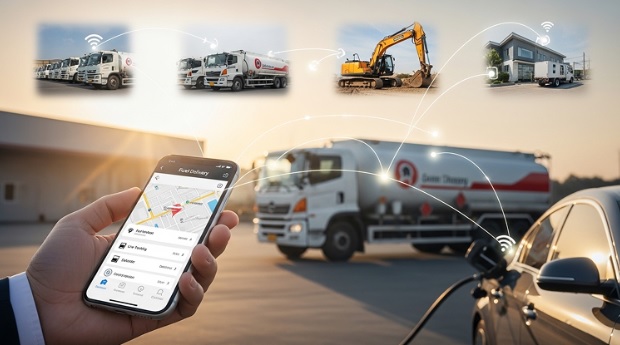
The Benefits of On-Demand Fuel Delivery
When we think about how much it costs to fill up our fuel tanks, we often think of the actual dollar figure, but in reality, refuelling costs us a lot more than just the price at the pump. Refueling can take time away from a driver, being a pain for a single driver out of route to get gas, but for a fleet owner who operates 50 vehicles in one city fuel costs become much more difficult to calculate when you have to factor in the time spent off route going to a gas station, difficulty tracking fuel card abuse in real-time, and reconciling drives with multiple vehicles to their expenditures at the end of the month is time-consuming and accounting staff does not have the time to handle that type of extra work.
On-demand fuel delivery removes the guesswork out of the equation because the scheduled delivery goes directly to the vehicle whether it is at a depot, job/New build or car park and the complete transaction is digitally recorded as part of the fuel delivery, giving the fleet operator total visibility of what was delivered, when it was delivered, to which vehicle and how much it cost.
The operational advantages alone will gain the interest of transportation companies, logistics providers, and large corporations with mixed fleets who will utilise on-demand fuel delivery services.
“The most advanced fuel delivery services are not simply replacing fuel station stops but are changing the refuelling experience between businesses and energy companies.“
How the Technology Works Behind the Scenes
For the end user, the experience is simple: open the app, drop a pin, choose fuel type and quantity, pick a time slot, and confirm. A certified delivery vehicle arrives, connects to your tank, fills it up, and sends a digital receipt. The whole interaction can take less than five minutes of your attention
Behind that simplicity, though, is a fairly intricate system doing a lot of heavy lifting. Route optimisation algorithms ensure that delivery vehicles cover ground efficiently and don’t make unnecessary trips. Inventory management tools keep supply aligned with demand forecasts. Real-time tracking gives customers visibility throughout the delivery. And payment, invoicing, and compliance documentation, particularly important for commercial clients who need records for audits, are all handled within the platform.
For businesses exploring this space, the technology architecture of a well-built solution matters enormously. This is one reason why many companies are turning to specialist teams for fuel delivery app development, rather than trying to adapt generic logistics software to a sector with
very specific safety, compliance, and operational requirements.
Who Is Actually Using These Apps?
The customer base is more diverse than you might expect. Individual drivers make up a portion of it, particularly in markets where app-based services have strong penetration, and people are used to on-demand everything. But the most commercially significant users are businesses.
- Fleet operators in logistics, delivery, and transport who need reliable, traceable refuelling for multiple vehicles daily.
- Construction and infrastructure companies whose heavy equipment stays on site and can’t easily be driven to a fuel station.
- Agricultural operations covering large land areas where machinery needs refuelling between jobs.
- Event management companies that run generators and support vehicles across temporary locations.
- Emergency and disaster response organisations that need a rapid, flexible fuel supply under unpredictable conditions.
In each of these cases, the on-demand model doesn’t just add convenience; it reduces downtime, improves safety by removing the need to transport jerry cans, and introduces a level of data visibility that simply didn’t exist before.
Why the Timing Is Right
Currently, many factors are coming together that are making this market commercially feasible. Most target markets have almost universal smartphone penetration. GPS accuracy has greatly increased to a degree where on-demand, precise location-based delivery can be completed reliably. The evolution in consumer and business expectations based on having used app-based services over numerous years across food, retail and logistics has permanently altered what is considered “normal” to receive service via on-demand delivery to a physical location of choice.
Regulatory frameworks governing fuel storage and transport in many parts of the world have also evolved significantly, providing clearer pathways for creating compliant delivery-based business models. Although the pandemic greatly accelerated contactless-first delivery-based service models, the habits of users being conditioned to these types of service solutions are continuing well after the event that created them.
See this article on modern logistics for further information on how digital platforms are revolutionising traditional service industries and for a foundational understanding of the bigger picture.
The Environmental Case — More Nuanced Than It Looks
A reasonable question to ask is whether sending a dedicated delivery vehicle to each customer location is actually better for the environment than having people visit centralised stations. The honest answer is: it depends on how the service is run.
When deliveries are batched efficiently, a single tanker refuelling multiple fleet vehicles in one location, the maths can favour delivery over individual station visits, particularly when you factor in the cold starts and detour driving that individual trips involve. Smart route optimisation within the platform reduces wasted mileage further. And several players in the space are already preparing for a future beyond petrol and diesel, positioning their infrastructure for CNG, hydrogen, and eventually mobile EV charging. The model is built for adaptability.
What the Future Looks Like
While it’s true that on-demand fuel delivery will not instantly overtake traditional petrol stations, and no one worldwide appearing within this cluster really believes such claims, what it will achieve is currently doing to capture an increasing (and continued) proportion of commercial fuelling within the commercial fuel market – especially where densities result in enhancing the commercial i.e. providing greater access, availability/use, and Lower Cost of Fuel at Point of Use Economic System supported by densified (urban) and peri-urban (semi-urban) markets.
Companies create upon creating a competitive advantage over their competition as the economic system develops/matures within the on-demand fuel market by constructing or implementing “best-in-class” solutions in terms of their business operations and providing access to critical business services required by both their business partners (customers) and themselves on time while also maintaining maximum efficiency and effectiveness from investment made or were made as input to constructing or assembling complete business infrastructures upon which operations are conducted and ultimately providing value through revenue generated we know today as “energy”.
Tanker Infrastructure is currently being constructed and deployed, as well as computer/digital platforms to connect and obtain/deliver replenishment of energy. Future decisions will determine how commercial businesses access energy beyond the next decade into this century.
Final Thought
The energy sector has always been defined by how efficiently it moves resources from where they exist to where they are needed. On-demand fuel delivery apps are the latest, and arguably the most user-centric answer to that challenge. They are not simply a consumer novelty. They are a structural shift in energy distribution, and the businesses paying attention now will be the ones best positioned when that shift reaches full speed.
Author Profile

- As a Digital Marketing and Content Strategist Planner at NectarBits, A Leading Software Development Company in the USA and a SaaS small business Solution in Canada, I am effectively behind the company’s content strategy, copywriting, brand communication, and operations. My prime focus is Content Marketing and ROI. I love writing and sharing knowledge. On weekends, I enjoy watching Tom and Jerry cartoons on TV.








Leave a Reply